


New tax laws are here: What small business owners need to know
H.R. 1, also known as the One Big Beautiful Bill Act (OBBBA), permanently extended several provisions from the 2017 Tax Cuts and Jobs Act (TCJA) and modified existing deductions, locking in changes that will shape both short- and long-term tax policy. To help you prepare for tax season, here’s what you need to know about these key changes and others, and what they mean for your business.
Background
One of the most widely discussed reforms to the tax code impacting small businesses is the Sec. 199A pass-through deduction.H.R. 1 made permanent and expanded the Section 199A deduction for businesses filing taxes as pass-through entities. Prior to the law’s enactment, Sec. 199A allowed businesses organized as pass-through entities to deduct up to 20% of their qualifying business income (QBI), which is broadly defined as a business’s net profit after deductions, from their annual federal taxes. While the deduction was set to expire, H.R. 1 permanently extended the 20% pass-through deduction. Although framed as a “small business deduction,” it’s important to note that more than half of the total benefit of 199A goes to the top 1% of earners, while Main Street small business owners with adjusted gross incomes under $100,000 receive an average deduction of less than $2,000, translating to few tax savings. Making this deduction permanent, without enacting structural reforms that drive increased tax relief to smaller, under-resourced businesses, widens the gap between Main Street businesses and the wealthiest taxpayers.
Key small business tax provisions to note this tax season
- Sec. 199A was extended and additional changes were made: In addition to making the deduction permanent, H.R. 1 increased the Sec. 199A deduction to 23% beginning with tax year 2026 (up from 20%), which impacts S-corps, partnerships and sole proprietors. For 2025, the deduction remains at 20%. Additionally, a new standard minimum deduction of $400 is included for those who earn at least $1,000 in QBI.
- Increased Sec. 179 small business expensing: The maximum amount for claims on software or equipment has doubled for inflation to $2.5 million beginning in 2026. This deduction allows businesses to write off certain property expenses like vehicles, technology or other business expenses needed throughout the year.
- 100% bonus depreciation: Businesses can fully deduct the cost of qualifying depreciable equipment upfront. The allowable deduction for past years was set to phase down following the 2017 tax law.
- Research and development and software costs can be expensed immediately: Businesses can once again deduct domestic research and development (R&D costs) immediately as opposed to amortizing these costs over a five year period. Firms with revenue below $30 million are able to amend prior tax years where costs would have been amortized to fully deduct the cost of R&D.
New Personal Income Tax Changes for 2025
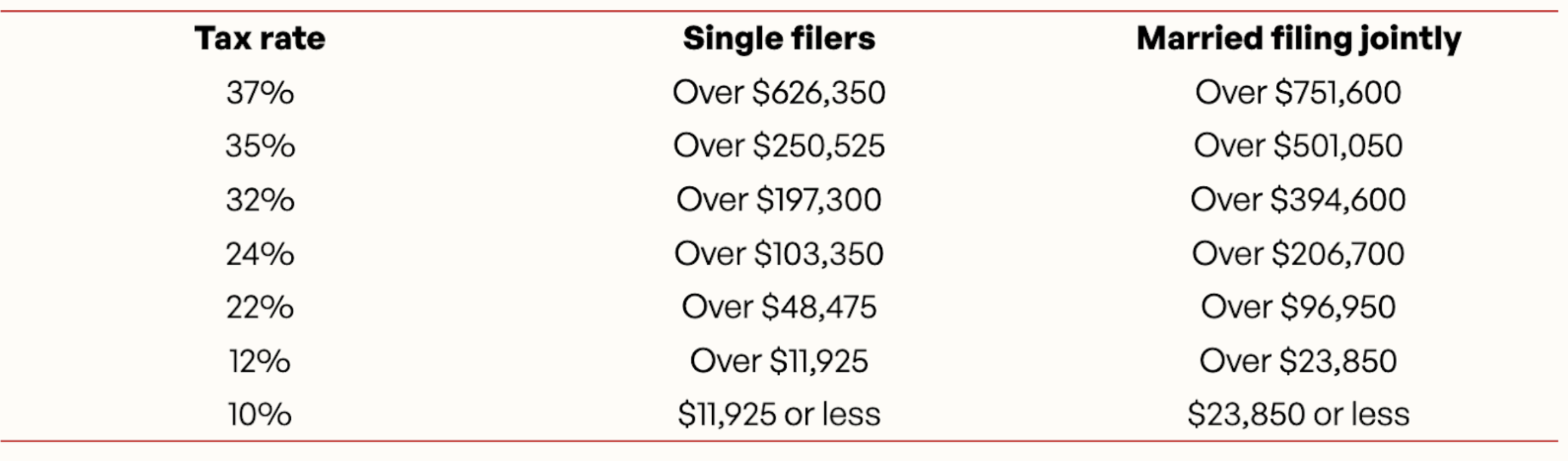
H.R. 1 also makes permanent the seven tax brackets adjusted by TCJA and adjusted for inflation. The brackets are as follows for the 2025 tax year:
Changes to Standard Deduction, Personal Exemptions and the Child Tax Credit
Additionally, H.R. 1 increases the standard deduction, with slightly higher amounts for 2025:
- $15,750 for single filers or those married filing separately
- $23,625 for heads of household
- $31,500 for married couples filing jointly or qualifying surviving spouses
The law also permanently eliminates personal exemptions for individuals, spouses and dependents and increases the Child Tax Credit to $2,200 per child.
Changes for workers and the self-employed
- The ‘No Tax on Overtime’ rule allows certain workers to claim a dollar-for-dollar deduction for a designated amount of overtime pay covered by the Fair Labor Standards Act.
- The new ‘No Tax on Tips’ law allows for a dollar-for-dollar for a designated amount of tips earned by workers in fields where tipping is customary.
- Starting in 2025, third-party apps or platforms are only required to send you a Form 1099-K if your total payments are more than $20,000 and if you received 200+ transactions on any one platform each year.
With these changes now in effect, small business owners should take time to review how the updates may impact their taxes, long-term planning and overall financial strategy. To learn more about H.R. 1 and what these changes mean for your business, watch our recent webinar.